Close up view of home with new windows
Based in Waxahachie, TX — Bells Chapel Road

Replacement Windows Engineered for DFW Summers, Not Northern Winters

Most window marketing is written for heating-dominated climates — triple-pane glass, maximum insulation, heat retention. That’s the right conversation for Minneapolis. It’s the wrong conversation for Waxahachie. DFW sits in the ENERGY STAR South-Central climate zone. Our cooling season runs six to seven months. The primary job of a replacement window here isn’t keeping heat in — it’s keeping heat out.

  • Family Owned Since 1995

  • ENERGY STAR South-Central Zone

  • BBB A+ Rated

  • Free Estimates

Why It Matters

Why DFW Homes Need the Right Replacement Windows

DFW’s climate puts specific demands on your windows that most national marketing ignores. Here’s what’s actually happening inside your home.

Solar Heat Gain

South-facing and west-facing windows absorb direct solar radiation from April through October. Older single-pane glass with an SHGC of 0.60+ allows the majority of that heat straight into your living space — forcing your AC to run harder and longer.

Chronic Hot Rooms

Rooms that face south or west stay uncomfortably warm no matter what the thermostat says. The glass isn’t filtering solar energy — it’s transmitting it. You’re cooling the room while the window heats it right back up.

Energy Waste

Windows account for 25%–30% of residential heating and cooling energy use according to the DOE. In DFW’s cooling-dominated climate, poorly performing windows are the single largest controllable factor in your summer energy bill.

Homeowners replacing original single-pane windows consistently report the difference is noticeable within the first day — rooms that were chronically warm on summer afternoons become comfortable at the same thermostat setting. That's the Low-E coating and argon gas working together to reject solar heat before it enters your home.

The Numbers That Matter

U-Factor and SHGC — And Which One Matters More in DFW

Every ENERGY STAR rated window carries an NFRC label with two critical performance numbers. In DFW, one matters significantly more than the other.

U-Factor measures how well a window prevents heat transfer — lower is better. In cold climates, it’s the dominant metric. In DFW, it matters but it’s not the primary driver. Solar Heat Gain Coefficient (SHGC) measures how much solar radiation passes through the glass and becomes heat inside your home. In our cooling-dominated climate, SHGC determines how hard your AC works from April through October.

  • U-Factor ≤ 0.28

    ENERGY STAR 7.0 requirement for the South-Central zone. Measures heat transfer through the glass assembly. Important, but secondary in DFW.

  • SHGC ≤ 0.23 — The Dominant Metric

    Blocks 77% of solar heat. Older single-pane windows may have an effective SHGC of 0.60 or higher. Replacing them cuts solar heat gain by more than half. Every window we install meets or exceeds this threshold.

  • Orientation Matters

    South-facing and west-facing windows get the most direct solar exposure and benefit most from low-SHGC glass. We assess every window by orientation so we can recommend the most cost-effective upgrade path — starting with the windows that deliver the largest energy reduction first.

The Glass

Low-E Glass — What It Is and Why DFW Needs It

Low-E stands for low-emissivity — a microscopically thin metallic coating applied to the glass during manufacturing. Invisible to the eye, it reflects specific wavelengths of energy — primarily infrared heat and ultraviolet radiation — while allowing visible light to pass through.

In DFW, the Low-E coating works as a solar shield. It reflects infrared energy before it enters your home, reducing heat load on your cooling system without darkening the room. A well-specified Low-E window lets in 50%–70% of visible light while blocking 70%–95% of UV radiation.

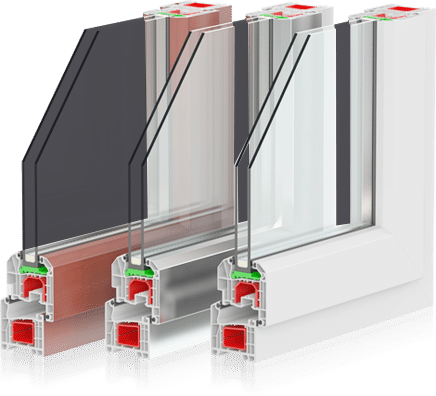
Modern dual-pane windows place the Low-E coating on the interior surface of the outer pane — surface #2 in industry terminology — maximizing solar heat rejection. The air space between panes is filled with argon gas, which is denser than air and reduces convective heat transfer between the glass layers.

Not sure which windows need replacing first?

We'll assess every window and prioritize by energy impact — starting with the ones costing you the most.

Frame Materials

Frame Materials We Install

The frame holds the glass, seals against air and water, and contributes to overall thermal performance. In DFW, selection is driven by thermal stability in extreme heat and UV resistance.
Close up view of a vinyl window
  • Most popular

  • Vinyl

    Most widely installed in the U.S. Affordable, energy-efficient, low-maintenance. Multi-chamber construction for insulation and rigidity. Doesn’t rot, rust, or require painting. Quality frames manage DFW’s 140°F–160°F south-wall surface temps through engineered expansion joints.

    Close up view of a fiberglass window
  • Premium

  • Fiberglass

    Maximum durability and thermal stability. Expands at nearly the same rate as glass — less seal stress over decades. Narrower frame profiles, more glass area, cleaner sightlines. Can be painted. Typically 40%–80% more per window than vinyl.

    Close up view of a painted wood clad window
  • Specialty

  • Wood & Clad-Wood

    Unmatched interior warmth and character — the choice for period homes. Queen Anne Victorians in Waxahachie, Craftsman bungalows in Ennis. Clad-wood adds aluminum or fiberglass exterior cladding for weather resistance. Premium-tier pricing.

    A note on aluminum frames: Strong and affordable, but aluminum is a highly efficient thermal conductor — the opposite of what you want in a DFW window frame. Even with modern thermal breaks, aluminum transfers more heat than vinyl, fiberglass, or wood. May not meet current ENERGY STAR requirements without significant modifications. We don’t recommend aluminum for residential replacement in our service area.

    Styles

    Window Styles We Install

    Close up of a home with double hung windows  in the DFW metroplex

    Double-Hung

    Heavy-gauge .027″ or .032″ coil stock. Corrosion-resistant (forms a self-protecting aluminum oxide layer), available in 27+ baked enamel colors. 20–30 year lifespan. Our most-installed material.

    Close up of a home with casement windows in Dallas

    Casement

    Heavy-gauge .027″ or .032″ coil stock. Corrosion-resistant (forms a self-protecting aluminum oxide layer), available in 27+ baked enamel colors. 20–30 year lifespan. Our most-installed material.

    Close up of a home with a picture window in the  M-Streets neighborhood in Dallas

    Picture

    Heavy-gauge .027″ or .032″ coil stock. Corrosion-resistant (forms a self-protecting aluminum oxide layer), available in 27+ baked enamel colors. 20–30 year lifespan. Our most-installed material.

    Close up of a home with sliding windows in Ellis county

    Sliding

    Heavy-gauge .027″ or .032″ coil stock. Corrosion-resistant (forms a self-protecting aluminum oxide layer), available in 27+ baked enamel colors. 20–30 year lifespan. Our most-installed material.

    Close up of a home with bay & bow windows in the DFW metroplex

    Bay & Bow

    Heavy-gauge .027″ or .032″ coil stock. Corrosion-resistant (forms a self-protecting aluminum oxide layer), available in 27+ baked enamel colors. 20–30 year lifespan. Our most-installed material.

    Close up of a home with arched windows in the Dallas area

    Specialty Shape

    Heavy-gauge .027″ or .032″ coil stock. Corrosion-resistant (forms a self-protecting aluminum oxide layer), available in 27+ baked enamel colors. 20–30 year lifespan. Our most-installed material.

    When to Replace

    Signs Your Windows Need Replacement

    Not every old window needs replacing. But certain conditions mean the window has reached the end of its functional life.

    • Condensation Between the Panes

      The sealed unit has failed. Argon gas has been replaced by moisture-laden air. The foggy appearance won’t clear — the window’s insulating value is permanently compromised.

    • Drafts Around Closed Windows

      Seal between sash and frame has deteriorated, or the frame has warped enough to create gaps. Conditioned air leaks out, hot air leaks in — all summer, all day. The energy cost compounds month after month.

    • Difficulty Opening or Closing

      Frame has shifted, warped, or swollen. On older wood: moisture-related. On older vinyl: thermal deformation. If it doesn’t operate smoothly, the seal isn’t performing when closed.

    • Visible Frame Damage

      Rot on wood, cracking or discoloration on vinyl, corrosion on aluminum. Once the frame is compromised, structural integrity, weathertightness, and insulating performance all degrade together.

    • Single-Pane Glass

      Any single-pane window is a replacement candidate in DFW. No insulating air space, no Low-E coating, no argon fill. Common in homes built before the mid-1980s across Waxahachie, Ennis, Midlothian, and Mansfield’s older neighborhoods. Replacing delivers the single largest energy efficiency improvement available.

    Not sure which windows need replacing first?

    We'll assess every window and prioritize by energy impact — starting with the ones costing you the most.

    The Complete Exterior System

    Windows and Gutters — Why We Install Both

    We’re a gutter company that also installs windows. That’s not an accident — the water your gutter system manages is the same water that threatens your window installation.

    Improperly functioning gutters allow water to overflow and run down the exterior wall. Over time, that water saturates the window frame, deteriorates the sill, compromises the seal between window and rough opening, and creates conditions for rot, mold, and structural failure — particularly on wood-framed windows.

    When we install replacement windows, we assess the gutter system as part of the same visit. If the gutters above the window are failing, undersized, or improperly pitched, we address both systems together. A new window below a failing gutter will have a shorter lifespan than the same window below a properly functioning gutter. We see the whole wall assembly, not just the opening.

    Why Us

    Why Metroplex Gutter and Windows?

    Not a national franchise. Not a lead-generation website. A family business based in Waxahachie since 1995.

    Climate-Matched Specifications

    We specify every window for DFW’s cooling-dominated climate — SHGC ≤ 0.23, Low-E glass tuned for solar heat rejection, argon-filled dual-pane construction. Not a national spec sheet with your city name swapped in.

    Orientation-Based Assessment

    We evaluate every window by compass orientation, not just condition. South and west exposures get priority because that’s where the energy loss is greatest. This lets us recommend the most cost-effective upgrade path.

    Whole-Wall Perspective

    Because we install both gutters and windows, we see problems that window-only companies miss — gutter overflow damaging frames, insufficient flashing, water entry above the window that compromises the seal below.

    No Pressure, No Scripts

    We’ll tell you which windows need replacing, which ones can wait, and what the honest investment looks like. No manufactured urgency. No “today-only” discounts. No national sales pitch.

    Where We Work

    Serving the DFW South Corridor

    Based on Bells Chapel Road in Waxahachie. Serving Ellis County, South Dallas County, and the southern DFW Metroplex.

    Ellis county – Our home base

    South Dallas County & DFW South Corridor

    Not sure if we serve your area? We probably do. Call (214) 306-4665

    Windows That Work for DFW — Not Just Windows That Sell Everywhere

    We'll assess your current windows, identify which ones need replacement, and recommend glass packages and frame materials matched to your home's orientation, your budget, and DFW's cooling-dominated climate. No pressure, no national sales script — just the right windows for where you live.
    Based on Bells Chapel Road, Waxahachie · Serving Ellis County, South Dallas County & the DFW South Corridor
    • Family Owned Since 1995

    • Insured & Bonded

    • BBB A+ Rated

    • ENERGY STAR South-Central